TheHood
Ad-hoc agent chats became governed local loops where models suggest, the runtime enforces, and users approve risky actions.
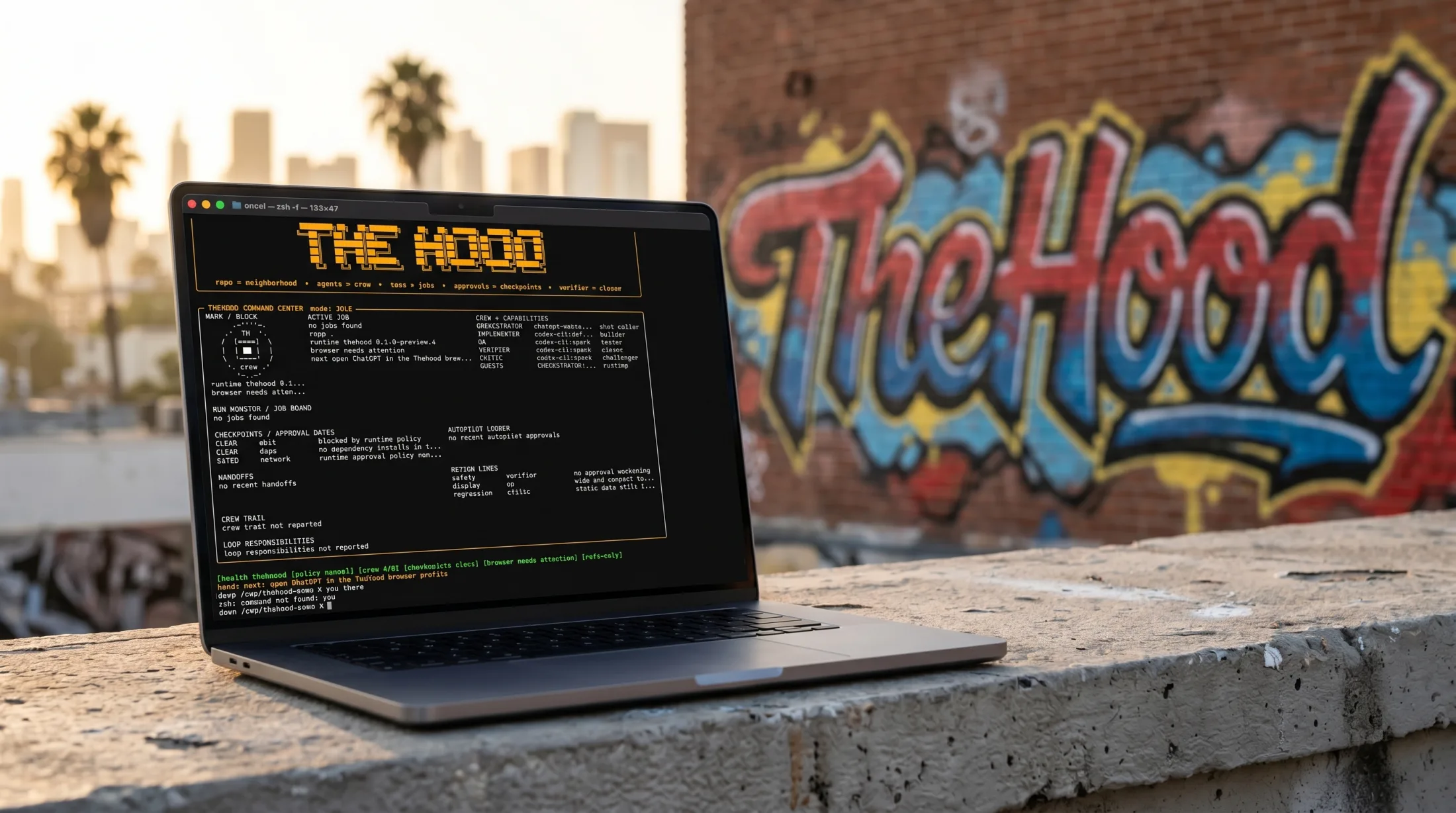
TheHood is an open-source runtime for serious agent work. It is not another chat surface, hosted scheduler, or magic autopilot. It is the layer that keeps provider choice, project permissions, approval gates, tool use, and evidence outside the model.
The premise is small and stubborn: models can suggest what to do, but the runtime should decide what is allowed to happen.
Why it exists
Agentic software work gets messy when the model is also the memory, the planner, the authority boundary, and the audit log. A chat can lose context. A local checkout can be dirty. A provider can be better at one role than another. A risky action can look like an ordinary next step unless something outside the model enforces the rule.
TheHood moves that control plane into a local runtime.
What it does
The runtime coordinates software-agent loops from Codex, a CLI, and MCP clients. A project can define roles, preferred providers, protected paths, approval policies, repo-context rules, and evidence requirements. The loop can then ask one model to plan, another to critique, another to implement, and another to verify, without pretending they all have the same authority.
ChatGPT Pro can be one of those role owners for strategy, architecture review, or reconciliation when the stakes justify it, but it still passes through the same runtime gates.
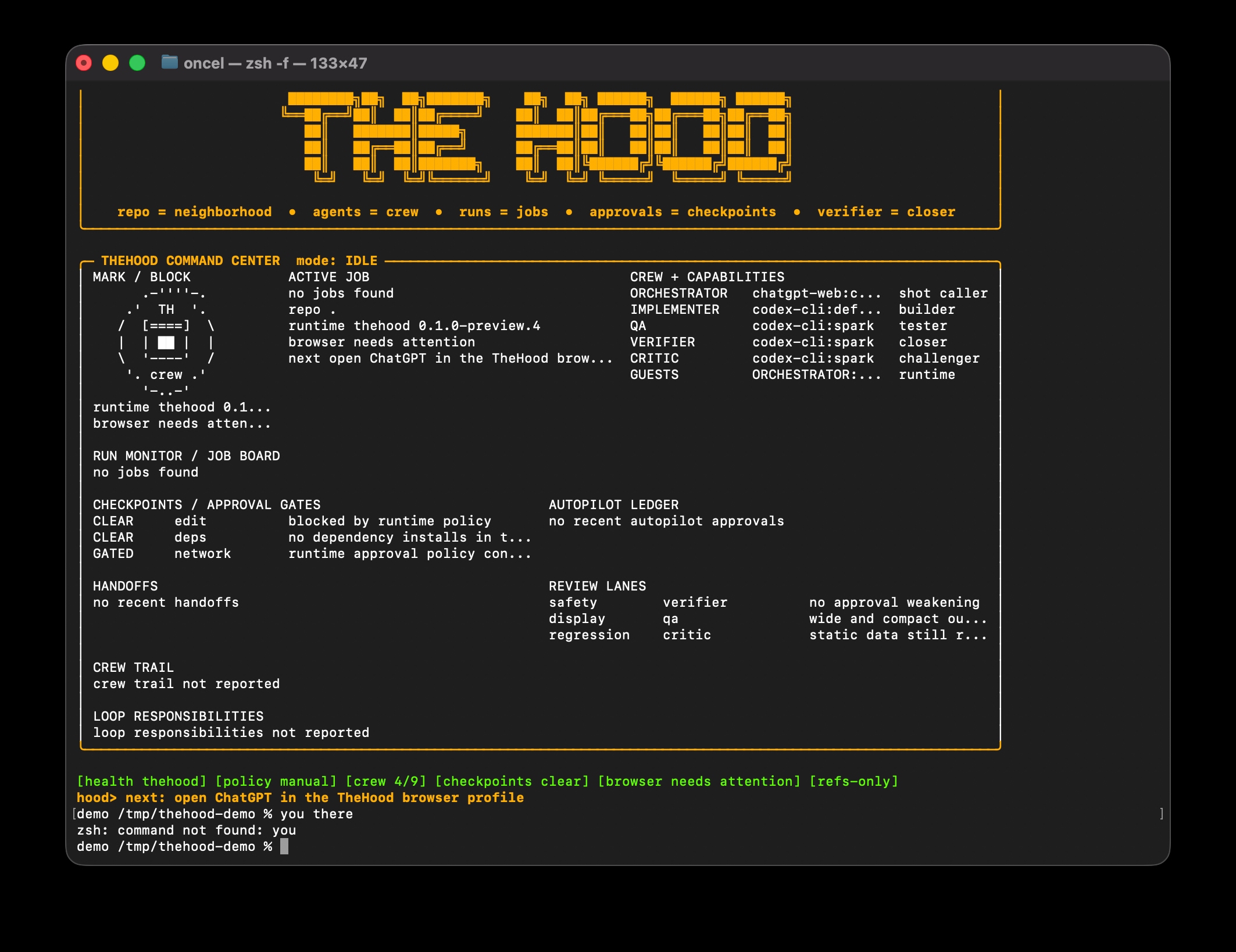
Manual gates stay explicit. The runtime can ask for approval before external model calls, repo-context transfer, writes, provider use, or bounded risky actions. The evidence lives with the run, not inside a disposable prompt.
Models suggest. The runtime enforces. Users stay in control.
The product decision
The important decision was to treat orchestration as a product surface, not as hidden glue.
TheHood owns the loop record, the approval state, the role map, and the boundary between local repo facts and external providers. That makes the system less theatrical and more useful: a guest agent can be a second judge, a critic, a QA tester, or a planner without getting silent authority over the project.
The result is a governed workflow for the kind of software work that already happens across Codex, Claude, ChatGPT, local models, CLIs, and MCP servers. The difference is that the runtime remembers what happened and why it was allowed.
What I own
Product model. Runtime architecture. CLI and MCP surfaces. Role assignment. Provider routing. Approval gates. Evidence capture. Repo-context policy. Local-first run records. Documentation. Public open-source packaging. The bridge between agent autonomy and human control.
Built with
TypeScript runtime for local governed agent loops, with Node, CLI commands, stdio MCP tools, JSON project configuration, provider adapters, role-bound orchestration, approval state, evidence records, protected-path policies, and local run artifacts.